Bedding · Materials · Care
How Vispring’s Quilted Protector Combines Wool and Cotton
A mattress protector is a quiet layer between the sleeper and the mattress, but its materials do more than soften the surface. In Vispring’s Lux Skirted Protector, a cotton cover and British wool filling bring different qualities to the same quilted layer: one provides the fabric envelope, while the other adds cushioning and helps manage moisture. Understanding how these materials work—and how the fitted design and care instructions affect everyday use—makes it easier to decide whether this style belongs on your bed.
Published November 27, 2026
A protective layer with more than one job
A protector sits beneath the fitted sheet and above the mattress. Its first task is practical: to help shield the mattress from perspiration, body oils, small spills, and everyday soil. But a layer that spends every night in close contact with the sleeper also changes the feel of the bed. Its fabric, filling, quilting, and fit can influence softness, airflow, and how easily the bedding stays in place.
Those functions are related, but they are not interchangeable. A thin, unfilled protector may offer a light barrier with little effect on the mattress’s surface feel. A quilted pad adds some cushioning as well as protection. A thicker topper is a different kind of layer, intended to alter the comfort of the bed more substantially. Knowing which job matters most is a useful first step before comparing materials.
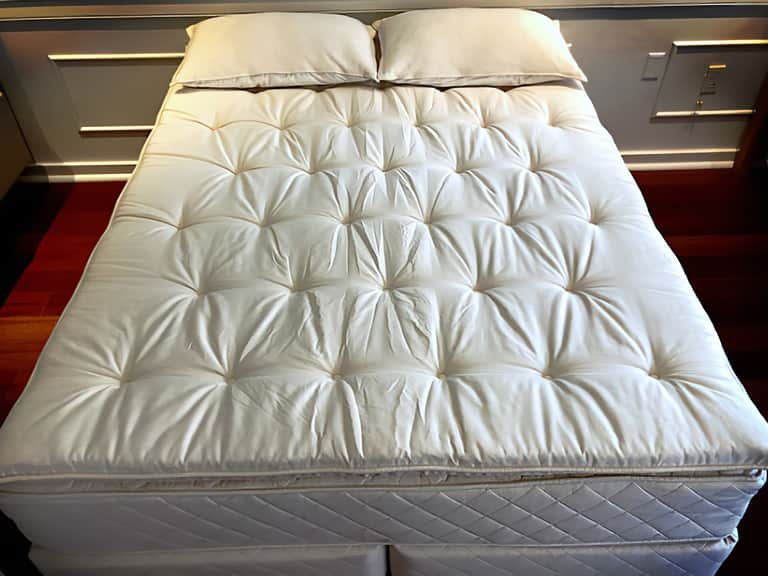
Vispring’s Lux Skirted Protector is described as a softly quilted, fitted layer with a cotton outer and British wool filling. The construction brings natural fibers into a practical bedding item, while its elasticated skirt is designed to keep it in place. For a shopper, the detail worth noticing is not simply that the product contains cotton and wool; it is how those materials, the quilting, and the fit work together—and what they require in care.
Read the product details for Vispring’s Lux Skirted Mattress Protector before choosing, especially to confirm current sizing and care guidance.
Cotton: the fabric against the sheets
Cotton is a familiar bedding fiber, valued for its soft hand and ability to allow air to move through a fabric. In a quilted protector, the cotton cover encloses the filling and forms the textile surface beneath the sheet. That role matters because the feel of a protector is shaped not only by its stuffing, but also by the cover’s weave, thickness, and finish.
A cotton cover can feel more substantial than a very thin synthetic barrier, while still being comfortable under ordinary bedding. The precise sensation depends on the fabric construction and the mattress beneath it. A protector with quilting may introduce a slight cushioned texture; a tightly fitted sheet above it can soften that impression, but may not erase it completely. If preserving the mattress’s original surface feel is a priority, look for a low-profile design and check whether the product description provides information about loft or thickness.
Cotton also has a practical relationship with moisture. It can absorb some moisture rather than acting as a waterproof shield. That distinction is important: the Vispring protector’s listed construction is cotton and wool, and the available product details do not describe it as waterproof. Someone seeking dependable protection from significant liquid spills, incontinence, or repeated wetting should verify the product’s barrier performance rather than assume that natural fibers alone provide waterproofing.
Terms such as “cotton cover” identify a material, not a complete performance guarantee. Thread structure, quilting, laundering, and the presence or absence of a waterproof membrane can all change how a protector behaves. For a mattress that needs a liquid barrier, compare the product’s stated construction with the specific protection required.
Wool: a resilient, moisture-managing filling
Wool contributes a different set of characteristics. Used as the filling inside the quilted cotton cover, British wool provides a soft layer of cushioning. Wool fibers are naturally crimped, giving them a springy structure that can create loft and resilience. In a protector, that does not mean the same thing as the deep contouring of a thick topper; it means a modest layer of softness under the sheet, with the exact feel shaped by the amount of filling and the quilting pattern.
Wool is also known for managing moisture. Rather than simply acting as a slick surface that sends moisture away, wool can take up water vapor within the fiber while retaining a comparatively dry feel at the surface. This may contribute to a more comfortable sleep climate for some people. It does not make wool a substitute for ventilation, and it cannot guarantee that every sleeper will feel cool. Room temperature, humidity, bedding layers, mattress construction, and individual physiology all have an influence.
The term “temperature regulating” is often used for wool bedding, but it is best understood as a material characteristic, not a promise of a particular body temperature. Wool may help buffer changes in warmth and moisture, yet a person who sleeps hot can still find a layered bed too warm. The overall system matters: a wool-filled protector under a dense duvet behaves differently from the same protector beneath a light sheet in a cool room.
In the Vispring design, wool is the filling and cotton is the outer fabric. That division gives each fiber a distinct role. The cotton forms the cover; the wool adds loft and a naturally resilient, moisture-managing layer. The combination is straightforward, but the outcome depends on details such as filling weight, quilting, mattress firmness, and the sleeper’s preferences.
What quilting changes
Quilting joins the cover and filling at intervals, helping keep the layers aligned. Without some form of anchoring, loose filling can shift or gather with regular movement. Stitching creates compartments or patterns that limit that migration and give the surface its familiar quilted appearance.
Quilting also influences how the protector feels. A close stitch pattern can make the surface feel more even and controlled, while a loftier construction may feel more padded. The product details describe the Vispring protector as softly quilted, but do not specify a stitch pattern or filling weight. Those are useful questions to ask if you are particularly sensitive to surface texture or are comparing it with another pad.
It helps to separate the purpose of a quilted protector from the purpose of a mattress topper. A protector is primarily intended to preserve the mattress and provide a washable or otherwise maintainable layer. A topper is generally chosen to change pressure relief, firmness, or overall cushioning to a greater degree. Quilting can add comfort, but a protector should not be expected to correct a mattress that is unsuitable for a sleeper’s needs.
Fit: why pocket depth deserves a measurement
The Lux Skirted Protector has a fitted design, with a secure pocket and fully elasticated skirt. The listed pocket depth is 13.75 inches. That measurement is one of the most important practical details to check before ordering. A protector that is too shallow may pull away from the mattress corners; one that is substantially too deep may sit loosely, wrinkle, or shift beneath the sheet.
Measure the mattress from its base to the top sleeping surface, including any pillow-top or permanently attached comfort layer. Do not include a separate topper unless you intend the protector to cover both the mattress and topper. If you use an additional layer, measure the combined height and compare it with the product’s stated pocket depth. The fit should accommodate the real assembled bed, not just the mattress dimensions printed on a label.
Also check the mattress size and shape. Standard labels such as Queen or King do not always resolve variations in dimensions, especially with specialist or split configurations. Confirm the product’s available sizes and whether the skirt is designed to fit your particular mattress. Elastic can help secure a fitted layer, but it cannot compensate for a mismatch in dimensions.
- Measure mattress height, including any built-in pillow top.
- Decide whether a separate topper will sit under the protector.
- Compare the complete bed height with the stated 13.75-inch pocket depth.
- Confirm size compatibility before purchase, especially for split or nonstandard beds.
Care is part of the material choice
A natural-fiber protector is only practical if its care routine suits the household. The listed care guidance for the Vispring Lux Protector recommends washing monthly. It calls for a gentle machine cycle in cold water with like colors and a natural detergent. Bleach and whiteners are discouraged; when necessary, the guidance recommends a non-chlorine alternative. For drying, line drying or tumble drying on low is advised, with prompt removal. Fabric softeners and dryer sheets are not recommended because they can reduce cotton’s absorbency.
These instructions should be treated as product-specific. Wool-filled bedding can be sensitive to excessive heat, agitation, and harsh chemicals, so it is unwise to substitute a general laundry habit for the manufacturer’s directions. Before washing, check the current care label and any instructions supplied with the item. A product’s care guidance can change, and the label attached to the protector is the most relevant reference for the item in hand.
Monthly washing is a suggested routine, not a universal schedule for every situation. The right frequency depends on use, household needs, and the manufacturer’s guidance. A protector used in a guest room may have a different laundering pattern from one used every night. Promptly addressing a spill and allowing bedding to dry fully before remaking the bed can also support hygiene.
Plan for drying time. If the protector is line dried, it may take longer to become completely dry than a thin synthetic layer. A damp layer should not be returned to the bed: trapped moisture can make the sleep surface uncomfortable and is undesirable for the mattress below. If using a tumble dryer, stay within the stated low-heat guidance and avoid assuming that a high-temperature cycle is safe simply because the fabric appears robust.
Washing can also affect fit over time. Cotton may change dimensions with laundering, and elastic components can experience wear. Following temperature and drying instructions helps reduce unnecessary stress on the fabric and skirt. If the protector begins to fit poorly, inspect the mattress measurements and the garment’s condition rather than stretching it forcefully over the corners.
How it compares with waterproof protectors
“Mattress protector” is a broad category. Some protectors are designed primarily for a breathable, comfortable surface; others include a membrane intended to prevent liquid from reaching the mattress. These goals can overlap, but they are not identical. Cotton and wool describe the fiber components of the Vispring quilted layer. They do not, by themselves, establish that the protector is waterproof.
For occasional perspiration and everyday contact, a breathable quilted layer may be an appealing choice, particularly for someone who wants a modest amount of cushioning. For a home where liquid accidents are a likely concern, look for an explicit waterproof specification and understand the barrier material, noise, breathability, and washing limits. Do not infer waterproof performance from words such as “protective,” “natural,” or “quilted.”
There is also a distinction between a fitted protector and a full encasement. A fitted protector covers the top and sides in the manner of a deep-pocket sheet. An encasement surrounds the mattress more completely, often using a zipper. People choosing bedding for specific pest, allergy, or contamination concerns should confirm that a product’s construction and claims match the need, rather than treating all protectors as equivalent.
Who might appreciate a wool-and-cotton layer?
A cotton-covered, wool-filled protector may suit someone who wants a natural-fiber layer with some cushioning, prefers a fitted design, and is comfortable following a careful laundry routine. It can also be a useful option for people who want to preserve a mattress while making the sleep surface feel slightly softer without adding a thick topper.
It may be less suitable when waterproofing is essential, when the mattress is taller than the stated pocket depth, or when frequent high-temperature washing is part of the household routine. People with sensitivities to wool or particular textile finishes should review the materials and seek clarification about the product’s construction. Natural materials are not automatically the right choice for every sleeper, and “natural” does not mean allergy-proof.
Comfort remains personal. A wool layer can feel inviting to one sleeper and too warm or textured to another. If possible, evaluate it in the context of the whole bed: mattress, sheets, duvet, room climate, and preferred sleeping position. A protector is one component in that system, not a stand-alone remedy for every sleep concern.
A practical checklist before choosing
Before selecting a quilted protector, move from general impressions to measurable questions. This makes comparisons more useful and helps avoid choosing a layer based on material names alone.
- Purpose: Decide whether you need surface cushioning, everyday soil protection, waterproofing, or a more complete encasement.
- Materials: Check which fibers form the cover and which make up the filling. Ask about membranes or coatings if liquid protection matters.
- Fit: Measure mattress height and compare it with the stated pocket depth. Include any layer the protector must cover.
- Feel: Consider whether quilting and added loft will complement the mattress or change its surface more than you want.
- Care: Review washing temperature, detergent guidance, drying method, and recommended frequency.
- Verification: Check the current product label and listing for size availability, construction details, and any updated instructions.
The quiet logic of natural fibers
The appeal of the Vispring Lux Skirted Protector lies in a simple division of labor. Cotton forms the cover; British wool supplies the filling. Quilting holds those layers together, and the elasticated skirt is intended to secure the protector around the mattress. The combination offers a softly cushioned alternative to a bare mattress surface while keeping practical details—fit and laundering—central to the decision.
That does not make it a universal solution. Wool’s moisture-management qualities are not the same as waterproofing, and a fitted protector cannot shield every part of a mattress as a zippered encasement might. Nor can a thin quilted layer replace a topper when substantial changes to firmness or pressure relief are needed. Choosing well means matching the construction to the real task.
For shoppers comparing wool bedding and cotton protectors, the most reliable approach is to look beyond a single fiber label. Consider how each material is used, how the layer is stitched, whether the fit matches the mattress, and whether the care routine is realistic. In bedding, durability and comfort often depend on these unglamorous details. They are the quiet architecture of a sleep surface—noticed most when the layer fits, feels right, and can be cared for as intended.
Frequently asked questions
Does a wool-filled mattress protector keep a sleeper cool?
Wool can help manage moisture and moderate the feel of a bedding layer, but no material can guarantee that a sleeper will feel cool. Room conditions, bedding, mattress construction, and personal preference all contribute to warmth.
Is the Vispring Lux Skirted Protector waterproof?
The available product details describe a cotton cover and British wool filling but do not specify a waterproof membrane. If liquid protection is necessary, confirm the current product specifications before choosing it.
How deep is its fitted pocket?
The listed pocket depth is 13.75 inches. Measure the mattress, including any built-in pillow top, and account for any separate layer the protector must cover.
How should it be washed?
The listed guidance recommends monthly washing on a gentle, cold-water cycle with like colors and natural detergent. Avoid bleach, whiteners, fabric softener, and dryer sheets; line dry or tumble dry on low. Always follow the product’s current care label.